Today, the Global Impact Coalition (GIC) publishes the findings of PFAS destruction technologies, prepared in collaboration with Boston Consulting Group.
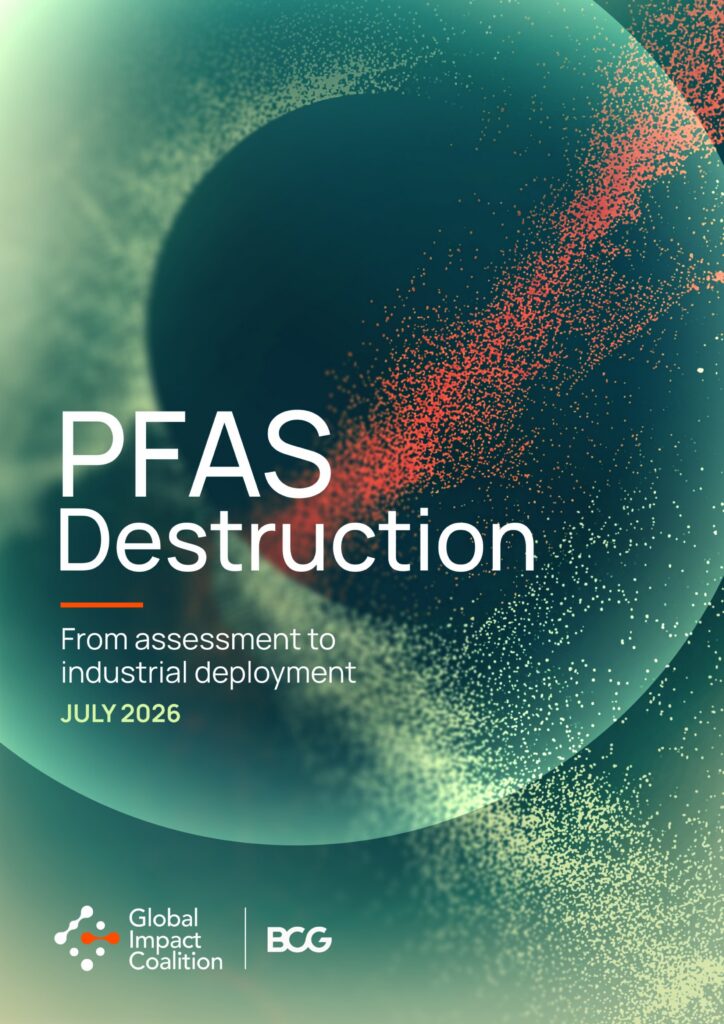
PFAS, often referred to as “forever chemicals”, are widely used across modern industry because they resist heat, chemicals and water. That same durability means they persist in the environment for decades, accumulating in soil, groundwater and drinking water while becoming the focus of increasingly stringent regulation and litigation. More than 6,400 PFAS related lawsuits have been filed globally, with over US$15 billion in settlements recorded. For industry, PFAS has become a material operational and financial risk.
No single company can realistically determine which destruction technologies are ready for industrial use. Every site has different water chemistry, different PFAS compounds and different operating conditions. Through the GIC, companies are pooling industrial wastewater samples, expertise and resources to generate an independent evidence base that allows technologies to be assessed consistently under real industrial conditions.
What the assessment confirms
This assessed more than 15 technology providers spanning 13 different approaches to PFAS treatment, creating one of the broadest cross industry comparisons conducted to date. The conclusion is clear: most commercially available technologies remove PFAS from water by concentrating it into another waste stream rather than permanently destroying it. The smallest and most persistent PFAS compounds, which are increasingly becoming the focus of regulation, remain particularly difficult to eliminate. While several emerging destruction technologies have shown promising results in controlled pilot testing, none has yet demonstrated reliable performance under continuous industrial operating conditions.
Why this matters now
Regulation is rapidly shifting from monitoring PFAS to requiring its removal. Proposed European limits, new US drinking water standards and national measures such as France’s PFAS discharge levy are raising expectations for permanent destruction rather than temporary treatment. Companies increasingly need confidence that technologies will perform reliably before making major investment decisions.
What comes next
The assessment provides a common evidence base for selecting the most promising destruction technologies. The next phase is shared industrial pilot testing on real process water to demonstrate continuous performance, validate operational economics and generate the data needed for commercial deployment and procurement. By working together, companies can reduce cost, accelerate learning and build regulatory confidence far faster than any organisation could achieve independently.
Companies facing PFAS compliance obligations across sectors including chemicals, semiconductors, pharmaceuticals and textiles are invited to join the next phase of the GIC project. Media outlets and industry publications are welcome to feature or republish the report. For further information or supporting materials, please contact the GIC team at contact@wearegic.com.
Download the full report here.