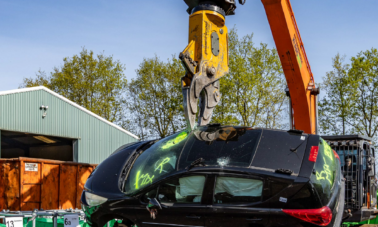
The Global Impact Coalition (GIC), a CEO-led platform enabling the chemical industry and its value chain to transition to a circular and net-zero chemicals future, announces that Jaguar Land Rover (JLR) has joined the coalition as a project member. JLR will be engaged in Phase II of GIC’s Automotive Plastics Circularity Project, strengthening cross-value chain collaboration to identify solutions for plastics recycling from end-of-life vehicles (ELVs).
 The project builds on successful results from Phase I, which demonstrated the technical feasibility of recovering plastics from ELVs with component and polymer specific insights.
Phase II represents a structural shift from pilot learning to industry scale implementation, with automotive manufacturers joining chemical companies to evaluate and address the economic feasibility of the value chain. JLR is one of three Original Equipment Manufacturers (OEMs) joining Phase II, bringing important expertise in vehicle design and circularity innovation. The company has been an early mover in automotive circularity through initiatives including its Circularity Lab and collaborations on polyurethane seat foam recycling.
JLR will help shape priorities for the next stage of the project, contributing to the development of a business case and industry roadmap for ELV plastics recycling. The company will also support the identification of priority vehicle components and collectively define demand-side specifications for recycled automotive plastics.
Another key focus of Phase II is design for recycling. Findings from Phase I showed that many automotive components are currently too complex to recycle cost-effectively. OEM participants will therefore co-develop design principles so future vehicles are built with end-of-life recovery in mind.
Charlie Tan, CEO of GIC, said:
“Welcoming JLR to the project is an important step forward. If automotive plastics recycling is going to scale, OEMs need to be part of the solution.
“Today, the challenge is not technology. It is that the plastics value chain was never designed to recover materials at end of life. As a result, recovery remains complex, inconsistent and often uneconomic.
“Our Phase 1 pilot and report showed that meaningful recovery is possible. The next phase is about addressing the structural barriers and moving towards implementation at industry scale. This requires coordination across the value chain to make automotive plastics circularity commercially viable.”
Paul Francis, Senior Manager, Circular Supply Chain, JLR said:
“JLR is excited to be part of this project. The value comes from working across the entire supply chain and combining our expertise. Part of our role is to clarify our material requirements whilst evolving our designs to better enable a circular supply chain. Our ability to do this is significantly enhanced through genuine partnership and collaboration.”
Phase II of the Automotive Plastics Circularity project comes at a critical time as the EU’s proposed ELV regulation would require new vehicles to contain 15% recycled plastics within approximately six years, rising to 25% within around ten years, compared with around 2.5% today.
By bringing together companies across the value chain, the Automotive Plastics Circularity Pilot demonstrates how industry collaboration can accelerate progress towards a circular automotive sector.